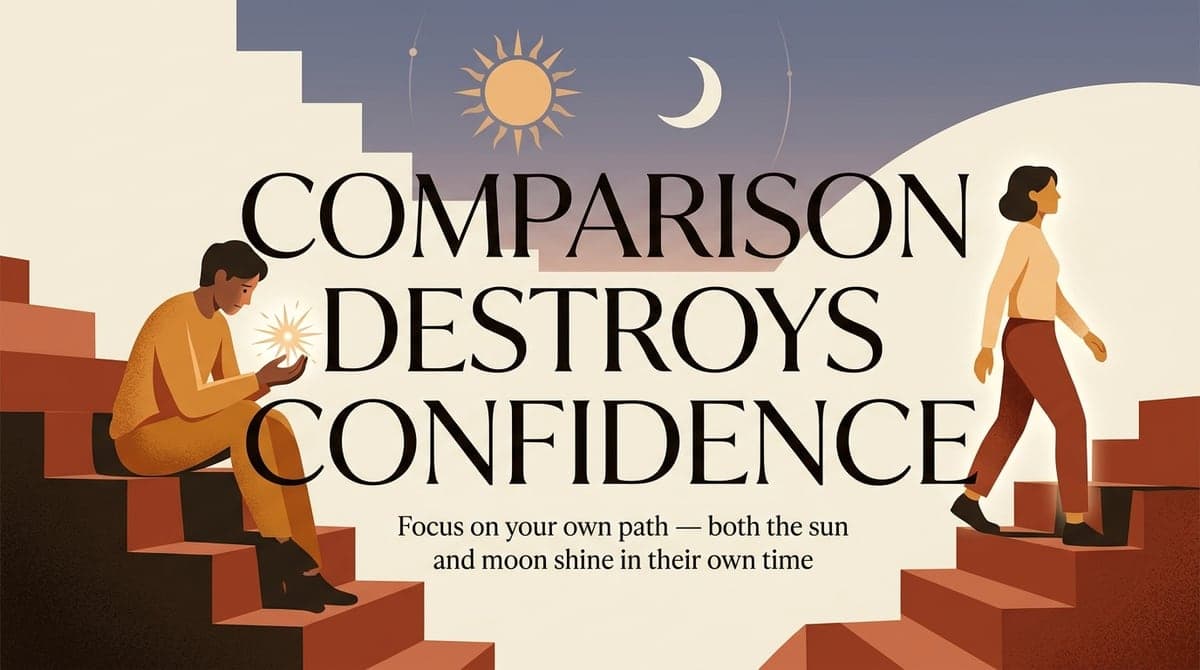
Why Comparison Destroys Confidence
Psychologist Leon Festinger first outlined Social Comparison Theory in 1954, demonstrating that human beings have an innate drive to evaluate themselves against others. However, modern research shows that upward social comparison reliably fuels inadequacy, envy, and cognitive fatigue.
Comparison often begins at home and continues throughout society. Most of the time, parents compare their children with others. As a result, children may start blaming themselves for their shortcomings. They begin to think, "Something is wrong with me." This leads to a loss of confidence.
That is how comparison kills confidence. It does not push a child to grow; it makes them feel small and trapped in repetitive loops. Learning how to stop overthinking and anxiety is essential to breaking this cycle and rebuilding genuine self-esteem.
The same thing happens in schools, offices, and even in our own minds. Let us look at each one.
Comparing Your Child with Others
Parents comparing their child to others is very common. Most of the time, it comes from worry or hope, not from a wish to hurt. Many parents think it will push the child to try harder. But the child often hears something else: "You are not good enough."
Here is a simple example. One student performs very well in school, and another student struggles. Instead of offering support or guidance, people compare the weaker student with the higher-achieving one.
But they fail to understand a simple truth: not every student is the same. Each person has different strengths, talents, and interests. One child may be good at studies. Another may be good at art, sports, music, or talking to people. Why comparing your child to others is bad comes down to this: it ignores who the child really is.
Students do this to themselves too. When you keep comparing yourself to other students, you only see their marks. You forget to look at your own strengths.
Rather than comparing, we should help people discover their unique skills and support them in finding what they can do best. Listening is a big part of this. You can read more about the power of listening.
| Instead of saying | Try saying |
|---|---|
| "Look how well your cousin did." | "What part was hard for you? Let's work on it together." |
| "Why can't you be like them?" | "I can see how hard you tried. Let's find what you enjoy and do well." |
| "They got more marks than you." | "Look how much you have improved since last time." |
Don't Compare Yourself to Others: The Sun and Moon
As a wise quote says:
"Don't compare your life to others. There's no comparison between the sun and the moon. They shine when it's their time."
This is one of the simplest don't compare yourself to others quotes, and it carries a big idea. The sun and the moon are both bright, but they are not the same, and they never shine at the same time.
It reminds us that everyone has their own time to grow and succeed. Comparing people not only steals their joy but also delays their progress. So the next time you feel like measuring yourself against someone, stop comparing yourself to others. Give yourself time.
Comparing Employees at Work Hurts Confidence and Performance
This problem is not limited to schools. Even in the business world, comparison can be damaging.
If a company compares one employee with another, it can break that employee's confidence and affect their performance. Companies should avoid comparing employees with each other.
If an employee is weak in some areas, employers should give helpful feedback and encouragement instead. This approach builds trust, increases motivation, and leads to better results. In the end, it helps the company grow and succeed.
| Comparing | Helpful feedback |
|---|---|
| "Ravi finishes twice as fast as you." | "Your reports have good ideas. Let's work on speed together." |
| Makes the person feel small | Shows what to improve and how |
| Lowers motivation | Builds trust and motivation |
It is easy to fall into this trap yourself. Comparing yourself to others at work, such as a coworker who got promoted first, can hurt your confidence in the same way. Every person has different strengths, different experience, and a different path. Focus on your own progress.
Comparison and Self-Esteem: The Effects of Comparing Yourself to Others
It is important to understand that constant comparison also affects your self-esteem. Self-esteem means how you see and value yourself.
When someone is regularly compared with others, they may start to feel less than others and lose belief in themselves. This can badly hurt their personal growth and their performance. Over time, a person may:
- Feel "not good enough," even after doing well.
- Be afraid to try new things.
- Lose joy in their own wins.
- Overthink small things.
But there is good news. When people are appreciated for who they are, their self-esteem improves, and so does their confidence.
Moral: Stop Comparing Yourself to Others
True transformation never comes from wishing to be someone else, as illustrated in the fable of the little mouse and changing your mindset; it begins when you accept who you are today.
Stop comparing people with others. Comparison destroys happiness, lowers self-esteem, causes overthinking, and disturbs mental peace. For some people, it can also add to stress and low mood.
Instead, focus on support and self-growth, because every person has the potential to shine in their own time.
How to Stop Comparing Yourself to Others: 5 Simple Tips
- Notice it: Catch the moment you start comparing, and pause.
- Compare yourself to yourself, not others: Ask: "Am I better than I was last month?"
- Write down your strengths: List three things you do well.
- Be happy for other people's success: Their time does not take away yours.
- Support, don't compare: Encourage others the way you want to be encouraged.
If some people around you keep making you feel small, you can read about the signs of fake people.
Stop comparing yourself to others, and start supporting them. That is how confidence grows in children, in employees, and in you.
Frequently Asked Questions
Does comparison destroy confidence?
Yes, it can. When people are compared with others again and again, they may start to feel less than others and stop believing in themselves. When they are appreciated for who they are, confidence grows.
Is it bad to compare your child to others?
Yes, it usually does more harm than good. Children may start to blame themselves and lose confidence. Every child has different strengths, talents, and interests, so support and guidance work better than comparison.
Why do parents compare their child to others?
Many parents do it out of worry or hope, thinking it will push the child to try harder. But comparison often has the opposite effect. The child hears "you are not good enough" instead of "I will help you."
Why is comparing yourself to others harmful?
It makes you look at what you lack instead of what you can do. It can steal your joy, lower your self-esteem, cause overthinking, and delay your progress, because everyone grows in their own time.
What happens if you keep comparing yourself to others?
You may start to feel less than others and lose belief in yourself. Over time, this can hurt your personal growth, your performance, and your mental peace. Comparing yourself with your own past is a healthier way to measure progress.
If comparison is making you feel low for a long time, talking to someone you trust, or to a counsellor, can help.