What is overthinking? Meaning and signs
For me, overthinking is when thoughts and emotions loop endlessly without leading anywhere useful. In modern life, our minds are constantly stimulated. We worry about our future, career, studies, relationships, past mistakes, and what other people might be whispering behind our backs.
Sometimes when someone hurts us, our mind gets trapped on one painful question: Why did they do this to me? We replay the conversation, analyze subtle facial expressions, and imagine different endings. The more we think, the harder it becomes to stay anchored in the present.
Signs of overthinking
The signs of overthinking are unmistakable once you learn to recognize them:
- Replaying past conversations and cringing over what you said.
- Second-guessing simple decisions until you feel stuck in analysis paralysis.
- Constantly imagining the worst-case scenario and convincing yourself it's imminent.
- Asking "what if" or "if only" repeatedly without ever arriving at a decision or action.
- Physical restlessness, difficulty concentrating, and muscle tightness.
Overthinking vs rumination: What is the difference?
While often used interchangeably, psychologists distinguish between general overthinking and rumination:
- Overthinking is a broader pattern of obsessive thinking that can look forward (catastrophizing about tomorrow) or look backward (second-guessing yesterday).
- Rumination specifically refers to getting stuck in a repetitive loop about past distress, mistakes, and losses. You chew on your sadness or regret like a cow chewing cud, asking "Why does this always happen to me?" without moving toward a solution.
Recognizing whether you are catastrophizing about the future or ruminating over the past is the first step toward breaking the mental loop.
Is overthinking good or bad?
Thinking itself is not bad. Constructive thinking has a clear purpose: planning for an upcoming exam, analyzing a budget, or thinking through the pros and cons of a job offer. Once you reach a decision or execute a plan, constructive thinking stops.
Overthinking, by contrast, is unproductive and circular. It produces worry instead of clarity, and doubt instead of decisions. Instead of solving a problem, it invents dozens of hypothetical problems that may never occur. Once thinking stops producing useful action and starts draining your energy and sleep, it has crossed into overthinking.
How overthinking affects your health
Constant overthinking wears down your body just as much as your mind. When you repeatedly play out worst-case disasters, your brain can't distinguish between an imagined threat and a real physical one. The effects of overthinking on the brain and body are profound: mental exhaustion, brain fog, and racing thoughts that refuse to quiet down.
According to research from the American Psychological Association (APA), prolonged psychological stress and continuous rumination keep your sympathetic nervous system on high alert. This chronic fight-or-flight activation elevates cortisol and adrenaline, which strains your cardiovascular system, suppresses healthy digestion, and disrupts deep, restorative sleep.
Similarly, clinical insights from the Mayo Clinic on anxiety and stress show that chronic worry and uncontrollable racing thoughts are primary drivers of tension headaches, unexplained muscle aches, and sleep disorders. Over time, physical exhaustion amplifies psychological vulnerability, creating a vicious cycle where tired minds overthink even more aggressively.
Is overthinking a mental illness?
Overthinking itself is not a mental illness or a clinical diagnosis—it is a cognitive habit that nearly every human experiences. However, persistent, uncontrollable overthinking and chronic rumination are core symptoms of generalized anxiety disorder (GAD), social anxiety, and major depression. If your thought patterns make it difficult to function, hold a job, or maintain relationships, speaking with a licensed mental health professional can provide structured clinical tools such as Cognitive Behavioral Therapy (CBT).
Why do we overthink? (Causes of overthinking)
If you have ever caught yourself asking, "Why do I overthink everything?", the answer lies in human evolution, fear, and control:
- Evolutionary negativity bias: Our prehistoric ancestors survived by scanning for threats. The brain that anticipated a predator behind the bush survived; the brain that assumed everything was fine did not. Today, that same survival mechanism makes our minds obsess over worst-case scenarios rather than best-case possibilities.
- The illusion of control: When life feels unpredictable, we subconsciously believe that analyzing every conceivable angle will protect us from pain or surprise. In reality, excessive thinking gives the illusion of control without the power of it.
- Perfectionism and fear of regret: We convince ourselves that if we just think a little longer, we will make a flawless decision with zero risk. This causes decision paralysis.
When emotions and fears run without intentional steering, our minds draft the catastrophe first. The habits below give you the tools to take the steering wheel back.
9 Simple habits to stop overthinking
1. Question your thoughts to challenge negative thinking
A thought is just a mental event; it is not a verified fact. When someone doesn't message back, your mind might instantly declare, "They don't respect me anymore." But the only verified fact you possess is that their phone hasn't replied yet.
Whenever you feel a negative thought spiral starting, pause and ask yourself two grounding questions:
- What do I actually know for certain?
- What am I assuming or imagining?
Then verify reality where possible. Anxious about an upcoming presentation? Revisit your speaking notes. Worried you offended a friend? Send a brief, friendly check-in.
How to stop overthinking in a relationship
Relationship overthinking is especially common. When a partner seems slightly distant, takes longer to text back, or speaks in a flatter tone, an overthinking mind immediately jumps to panic: "Are they falling out of love? Did I do something wrong?"
To stop overthinking in a relationship or close friendship:
- Separate their mood from your worth. People get tired, stressed at work, or preoccupied with family issues.
- Avoid mind-reading. Instead of building an entire narrative alone in your room, practice open communication: "Hey, you seemed a bit quiet today. Is everything okay?"
- Trust facts over feelings. Look at their overall pattern of care and commitment rather than hyper-analyzing a single three-hour silence.
2. Stop feeding your overthinking
This habit comes straight from personal experience. Whenever I used to feel overwhelmed by repetitive thoughts, my instinct was to open Instagram and mindlessly scroll through Reels to distract myself.
Then something strange happened: the algorithm picked up on my mood. My feed began serving video after video about heartbreak, regret, loneliness, and psychological struggles. One video led to the next. Within forty minutes, I wasn't distracted at all—I was consuming dozens of emotionally charged clips about the exact worry I was trying to escape.
Social media algorithms are optimized to hook your current emotional state. When you feed your overthinking with relatable sad content or debate threads, you keep your nervous system submerged in the problem. When you notice yourself looping, close the app immediately.
3. Step away from the trigger
When a thought loop becomes overwhelming, the fastest relief comes from changing your physical environment:
- Set your phone face-down in another room.
- Step outside into fresh air and sunlight for ten minutes.
- Do a light stretch, take a brisk walk, or drink a tall glass of cold water.
- Listen to instrumental music or an audio story that requires zero personal analysis.
Stepping away interrupts the sensory feedback loop. It lets your emotional nervous system reset without feeding the fire of your negative thoughts.
4. Talk to someone you feel safe with
Speaking your thoughts aloud diffuses their power. But be selective about who you confide in. When you are already vulnerable, talking to someone dismissive, judgmental, or hypercritical can make you feel twice as anxious.
I am fortunate to have my sister. She knows me deeply. When I talk to her, I don't need to censor my thoughts or worry that my fears sound silly. She listens without judging, and she stands by me when I struggle with my own mind. When she needs support, I am right there for her in return.
That two-way trust is the foundation of genuine emotional safety. It also highlights the power of listening—giving someone space without rushing to fix or lecture them. You don't need a crowd of people; just one grounded person can keep you tethered to reality.
5. Write it down: journaling to stop overthinking
When thoughts stay trapped inside your head, they bounce around, amplify, and repeat endlessly. Putting them down on paper pulls them out of the abstract realm and forces them into linear words.
Whenever your thoughts feel tangled, open a notebook and answer these four prompts:
- What actually happened? (Facts only, no storytelling.)
- How do I feel right now?
- What is the worst thing I'm afraid of?
- What is within my direct control today?
Once written, worries usually look surprisingly small and manageable compared to how loud they sounded in your head.
How to stop overthinking before bed (when you can't sleep)
If you can't sleep because of overthinking, you are dealing with a classic bedtime phenomenon: daytime distractions disappear, the room gets quiet, and your brain uses the silence to process every unresolved worry.
To stop overthinking before bed:
- Do a 5-minute brain dump: Keep a pen and notebook on your nightstand. Write down tomorrow's to-dos, unfinished worries, or stray thoughts 30 minutes before turning off the light. This sends a psychological signal that your concerns are safely recorded and don't need active monitoring overnight.
- Enforce a phone curfew: Blue light and notifications stimulate alertness. Keep your phone out of arm's reach.
- Focus on sensory grounding: Use the 4-7-8 breathing method or focus entirely on the physical sensation of the blanket against your skin to pull attention out of your head.
6. Ask: "What can I do right now?" (Break analysis paralysis)
We waste countless hours trying to solve imaginary crises months in advance. What if my plan fails? What if people laugh? What if I choose the wrong path?
In The Art of Not Overthinking, author Shaurya Kapoor captures this trap brilliantly:
"Overthinking complicates everything and simplifies nothing."
When you catch yourself paralyzed by options, ask one decisive question: "What is one small thing I can do right now?"
- If there is an immediate action—send the email, submit the form, outline the first paragraph—take that single micro-step. Action dissipates anxiety.
- If there is nothing you can do right now (it's 2 AM or the decision rests with someone else), acknowledge that additional hours of worry will not alter the outcome by a single millimeter.
7. Let other people's opinions go
We burn immense mental bandwidth wondering what colleagues, acquaintances, or distant relatives think of our decisions. But not every opinion is valid, and very few are informed by your lived experience.
Before taking someone's critique to heart, ask yourself:
- Does this person know my character and values?
- Are they speaking with genuine goodwill?
- Have they walked the path I am trying to walk?
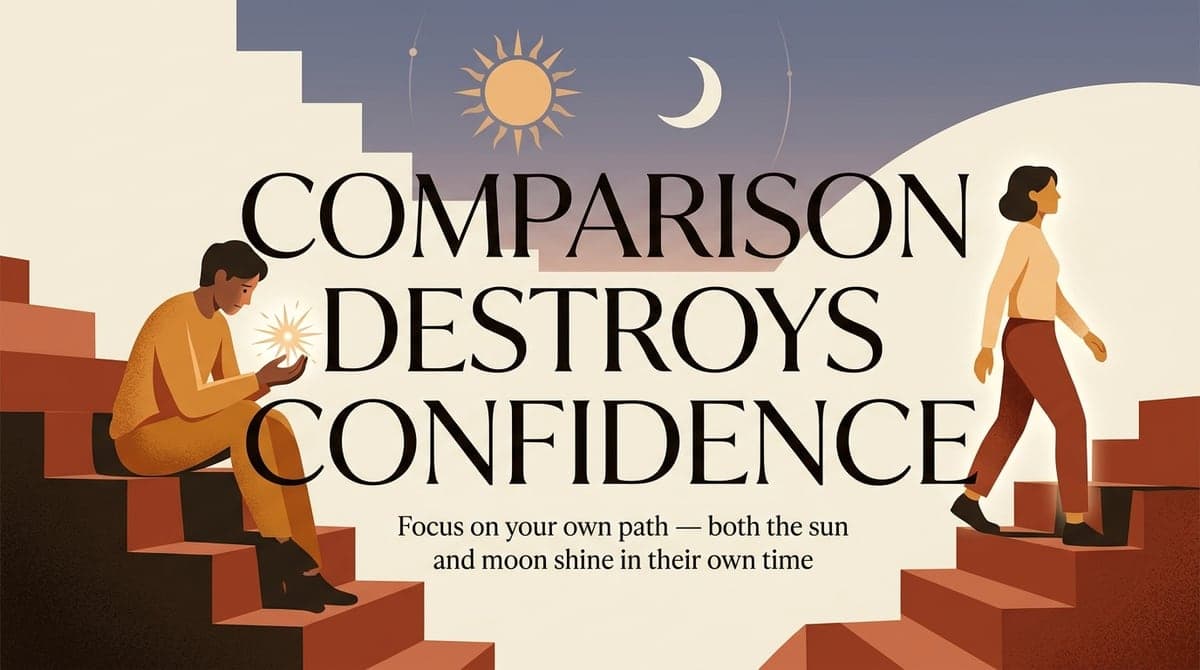
If the answer is no, let their opinion drift away. Constantly measuring your life against other people's expectations will always lead to self-doubt—just like how comparison destroys confidence.
8. Notice who drains your mind
Certain people reliably leave you feeling anxious, questioned, or small after every interaction. If spending time with someone consistently triggers an overthinking spiral about your worth or choices, take note.
Healthy relationships bring mutual respect and emotional ease. If someone's pattern is manipulative or exhausting, remember that setting clear boundaries is an act of self-preservation. Take time to understand the signs of fake friends and people so you can protect your inner peace.
9. Be kinder to yourself (self-compassion)
The most damaging overthinking is usually directed inward. When something goes wrong, we berate ourselves: "Why did I say that? I'm so clumsy. I always ruin things." We speak to ourselves with a cruelty we would never direct toward a close friend or a younger sibling.
Research by Dr. Kristin Neff shows that self-compassion, not self-criticism, is what fosters emotional resilience. When you catch yourself in a self-blaming loop:
- Acknowledge that making mistakes is part of being human.
- Speak to yourself in the same encouraging, patient tone you would use with a best friend who is hurting.
- Remind yourself: A mistake is an event, not your identity.
Key ideas from The Art of Not Overthinking
Shaurya Kapoor's book The Art of Not Overthinking offers several practical takeaways that align closely with daily mindfulness:
- Thoughts are not commands: Having a catastrophic thought does not mean you are required to believe it or act on it. You can observe a thought like passing traffic and let it drive away.
- Action destroys rumination: Overthinking thrives in stillness and hesitation. Moving your physical body or taking one micro-action immediately shifts neural activity away from the default mode network (the brain's daydreaming and worrying center).
- Acceptance of imperfection: Peace comes not from guaranteeing that nothing will ever go wrong, but from trusting your capability to rebuild and adapt if it does.
When to ask for help
Occasional overthinking is completely normal. However, if repetitive negative thoughts have persisted for weeks, consistently rob you of sleep, provoke panic attacks, or interfere with your daily work and relationships, reaching out for professional guidance is the wisest step you can take.
A licensed therapist or counselor can provide evidence-based strategies such as Cognitive Behavioral Therapy (CBT) or Acceptance and Commitment Therapy (ACT) to help you untangle stubborn thought loops. Reaching out for support is never a sign of weakness; it is a sign of self-awareness and strength.
Frequently asked questions about overthinking
How do I stop overthinking right now?
Interrupt the mental loop by shifting your physical state. Take three slow belly breaths (inhale for 4 seconds, exhale for 6), put down your screen, and change your physical room or step outside. Ask yourself: "What is one concrete thing I can do right this second?" If there is an action, take one small step; if not, redirect your attention to a physical task like washing your hands or walking.
What is the difference between overthinking and rumination?
Overthinking is an umbrella term for repetitive, unproductive thinking that can look forward to future catastrophizing or backward to past events. Rumination specifically focuses on rehashing past mistakes, regret, loss, and asking "Why me?" without moving toward resolution.
Why do I overthink everything?
Overthinking everything usually stems from three root causes: the human brain's natural negativity bias (scanning for danger), an attempt to gain a false sense of control in uncertain situations, and perfectionism (fear of making the wrong choice).
How do I stop overthinking before bed when I can't sleep?
Keep a paper notebook beside your bed and do a 5-minute "brain dump" before sleeping. Write down everything competing for your attention so your brain knows the data is safe. Remove your phone from the bedroom and use gentle 4-7-8 breathing to relax your nervous system.
How do I stop overthinking in a relationship?
Separate verified facts from imagined assumptions. A delayed text or quiet mood usually means someone is busy or tired, not that they are leaving. Instead of analyzing silence alone, practice clear and gentle communication, and judge the relationship by consistent long-term actions rather than momentary fluctuations.
Is overthinking considered a mental illness?
No. Overthinking is a common mental habit, not a diagnosable medical condition. However, chronic overthinking and rumination are frequent symptoms of clinical anxiety and depression. If it disrupts your daily functioning for extended periods, consult a doctor or therapist.
Is overthinking always bad?
Not all deep thinking is bad. Deliberate, structured thinking helps you evaluate options and reach decisions. It turns into harmful overthinking when thoughts loop repetitively without producing action, causing chronic anxiety, indecision, and exhaustion.
Can journaling really help stop overthinking?
Yes. Writing externalizes internal thought loops. Putting racing thoughts onto paper moves them out of working memory and into a structured format, making fears look noticeably smaller, clearer, and easier to solve.
Will I ever stop overthinking completely?
No, and you don't need to. Human minds naturally produce thoughts, fears, and ideas throughout the day. The goal is not a completely silent mind, but learning to observe your thoughts without believing every catastrophe they present.
Final thoughts
You may never completely eliminate overthinking from your life, and you don't have to. Your mind will continue to produce thoughts, fears, and hypotheticals. The real shift happens when you realize you don't have to believe or entertain every single one of them.
Don't try to apply all nine habits simultaneously. Start with just one today: take a ten-minute walk without your phone, write three honest lines in a notebook before bed, or have one open conversation with someone you trust.
For me, being able to talk openly with my sister has been a lifesaver. Having even one person who listens without passing judgment makes life's heaviest moments feel bearable. I hope you find that kind of safety, and more importantly, learn to extend that same gentle patience to yourself.
You are not the thoughts racing through your head. You don't have to solve every hypothetical "what if." Your real life is waiting for you right now, outside of your thoughts.
This post is inspired by core ideas from The Art of Not Overthinking by Shaurya Kapoor.